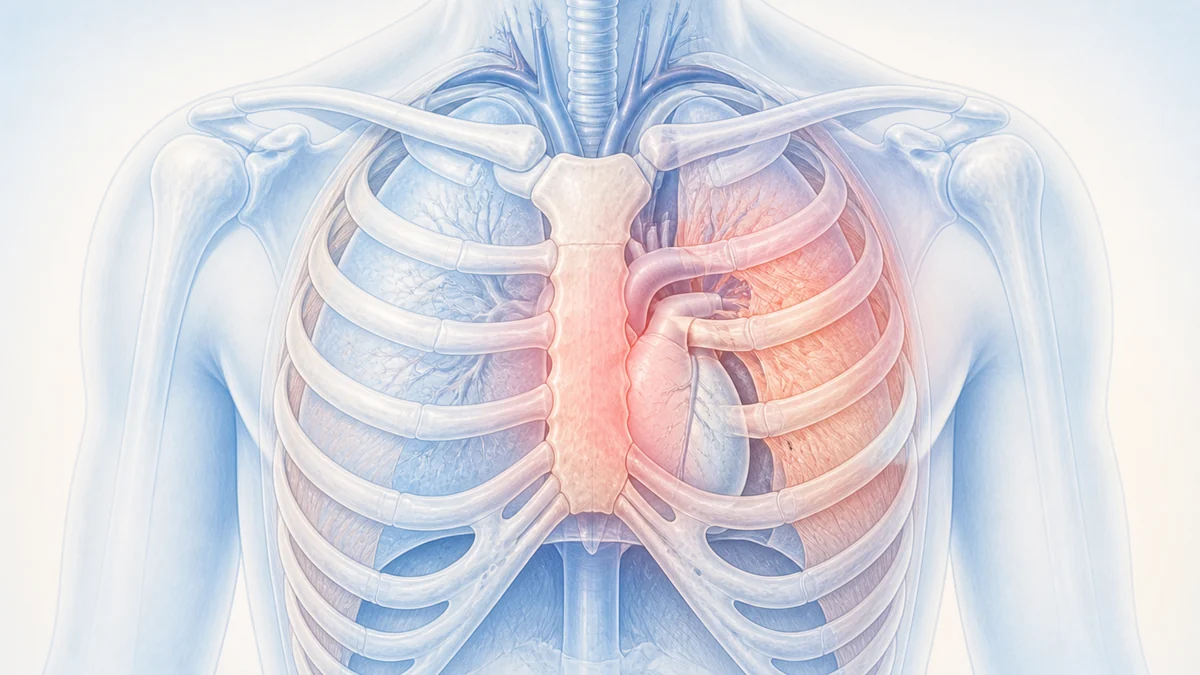
Chest pain is always worrying, and rightly so: it is one of the few symptoms where the first question is not “what is it?” but “should I call for help?”. Here is how to recognise what cannot wait, what calls for a consultation, and the most common causes that are not serious.
When you must call 101 immediately
Call 101 (Magen David Adom) without delay, and do not drive yourself, if you notice any of these signs:
- a crushing, heavy or tight pain in the middle of the chest that lasts more than a few minutes;
- pain that radiates to the left arm, the jaw, the neck or the back;
- pain accompanied by sweating, nausea, paleness or feeling faint;
- sudden breathlessness, difficulty breathing;
- a tearing, very intense pain that is at its worst from the very first moment;
- feeling faint, losing consciousness or rapid palpitations that are hard to bear.
These signs do not wait for confirmation. A call for nothing is infinitely better than a heart attack treated two hours too late: the treatments that save the heart muscle depend on that window of time. And a crushing pain that has gone away on its own is not a pain that has been dealt with: it must be assessed the same day.
In women, the signs are often different
The classic picture — the pain that tightens and travels down the left arm — mostly describes men. In women, a heart attack more often shows itself as sudden, unusual tiredness, breathlessness, nausea, pain in the back or the jaw, or a vague feeling of being unwell.
These less dramatic symptoms are one of the reasons women call later, and are treated later. Faced with unusual chest discomfort, age and sex should never be reassuring on their own. In practical terms: in a woman, sudden, unexplained tiredness accompanied by nausea, breathlessness, or pain in the back or the jaw calls for the same reflex as a crushing pain — call 101.
The most common causes that are not serious
Once an emergency has been ruled out, most chest pain has a cause that is not serious:
- muscle or rib pain: it is brought on by pressing with a finger, by movement or by coughing, and changes with position — this is the most common cause;
- acid reflux (gastro-oesophageal reflux): a burning that rises behind the breastbone, often after a meal or when lying down;
- anxiety or a panic attack: tightness, short breathing, tingling in the hands, a lump in the throat;
- a chest infection: pain that comes with the cough, sometimes with a fever.
A useful pointer, though it never replaces medical advice: pain that is reproduced by pressing on the chest, or clearly changed by position and breathing, points more towards chest wall pain — that is, the wall of the chest — than towards the heart.
When should you see a doctor the same day?
If none of the emergency signs above are present, see a doctor the same day if:
- the pain comes back on exertion and eases with rest — this pattern must be investigated; and if the episodes are getting closer together, are brought on by lighter and lighter effort or appear at rest, do not wait for the consultation: call 101;
- it comes with a fever or a persistent cough;
- it occurs in someone with diabetes or high blood pressure, or who smokes, with high cholesterol or a family history of heart disease;
- it has been going on for several days with no explanation;
- you are over 40 and have never had this kind of pain assessed.
A consultation makes it possible to examine you, to put the pain in context, and to decide whether an electrocardiogram (ECG) or further tests are needed.
What not to do
Three mistakes come up again and again, and they are the ones that cost the most:
- waiting to see whether it passes, when the pain is crushing and lasting;
- driving yourself to the emergency department: feeling faint at the wheel turns an emergency into an accident;
- taking a medicine on your own initiative, in particular aspirin: it is sometimes useful, but that decision belongs to the 101 dispatcher or the doctor, not to you.
The right reflex is simple: if there is any serious doubt, call 101 and describe what you feel. That is exactly what the service is there for.
After the emergency: understanding and prevention
When a cardiac cause has been ruled out, worry often remains — and it is legitimate. Talking it through with a doctor helps to put a name on what happened, to identify the risk factors that can be corrected (smoking, blood pressure, cholesterol, diabetes, lack of exercise, sleep, stress), and to know which signs should prompt a reaction next time.
For people at risk, regular follow-up is worth more than a single test done in the heat of the moment.
Seeing Dr Nathalie Gozlan
Dr Nathalie Gozlan, a general practitioner and a specialist in emergency medicine, sees patients for a check-up after chest pain, for the assessment of cardiovascular risk factors, and for follow-up — as a home visit in the Sharon region (Netanya, Kfar Saba, Raanana, Kadima-Tzoran, as well as the moshavim and kibbutzim of the area), or by video consultation anywhere in Israel, in English, Hebrew and French.
Chest pain that is happening now, however, is not a reason for a remote consultation: call 101.
Frequently asked questions
How can you tell muscle pain from heart pain?
Pain that is reproduced when you press on it with a finger, or that changes with position or breathing, points more towards the wall of the chest. A crushing pain that lasts, radiates to the arm or the jaw, and comes with sweating or breathlessness means you should call 101. No pointer is 100% reliable: when in doubt, call.
Is a brief pain lasting a few seconds worrying?
A very brief stab, lasting a second or two, that does not come back and is not accompanied by any other sign is rarely of cardiac origin. If it recurs, comes on with exertion or is accompanied by breathlessness, it deserves medical advice.
What should you do while waiting for the ambulance?
Stop all activity and sit or lie down in a comfortable position. Do not drive. Leave the door unlocked so the crew can get in. If you take a heart medicine prescribed for this kind of pain, follow the instructions you were given. Do not take any other medicine on your own initiative, unless the 101 dispatcher asks you to.
Can chest pain be managed by video consultation?
No, not pain that is happening now: a physical examination and an electrocardiogram (ECG) are essential, and time matters. The video consultation has its full place AFTER the episode — to understand what happened, assess the risk factors and organise follow-up. For pain happening now, the right number is 101.