Burning when you urinate, a constant and urgent need to go, the feeling that your bladder is never quite empty: cystitis is one of the most common infections in women. It is usually not serious and clears up quickly with the right treatment — provided you can spot the situations that do call for prompt medical advice.
What is cystitis?
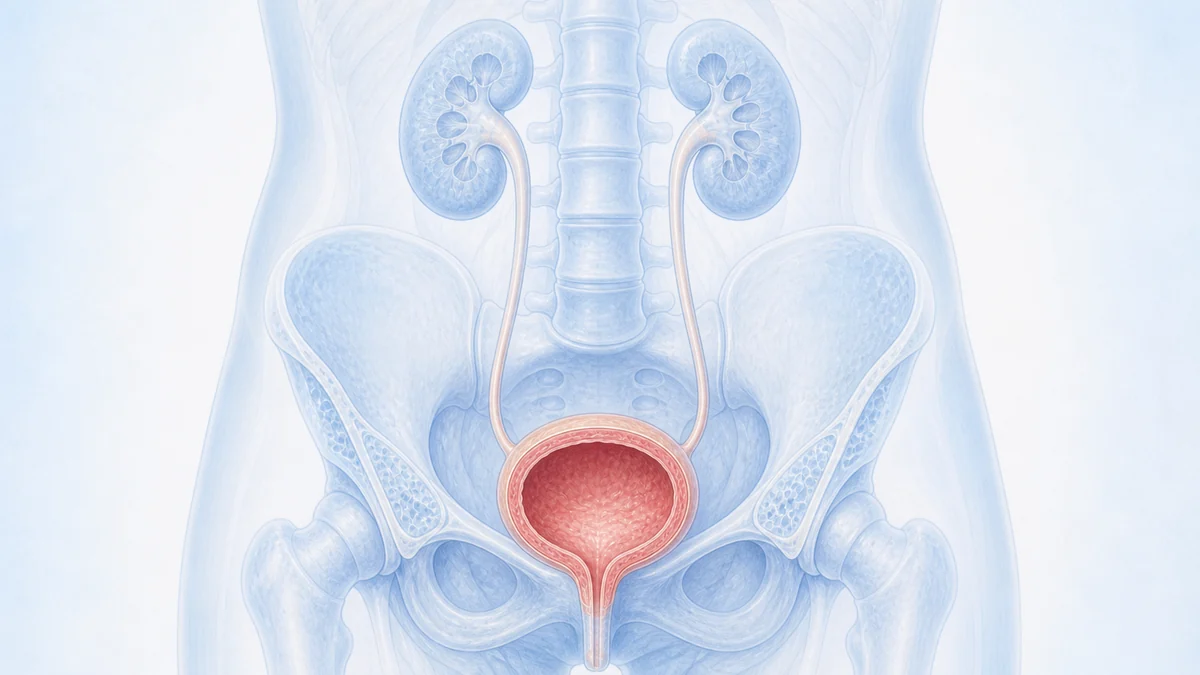
Cystitis is an infection of the bladder, almost always caused by a bacterium from the bowel that travels up the urethra. It mainly affects women: the urethra is short, which makes it easier for germs to reach the bladder. One woman in two will have at least one episode of cystitis in her lifetime.
In its usual form — what doctors call simple cystitis, in a woman who is not pregnant and has no other medical condition — the infection stays confined to the bladder. It is uncomfortable, sometimes very painful, but it is not dangerous and it clears quickly with the right treatment.
The symptoms of cystitis
Three signs are present in almost every case:
- a burning feeling or pain when you urinate;
- an urgent need to go, again and again, sometimes every ten minutes, only to pass a few drops;
- a heaviness or pain just above the pubic bone, low down in the abdomen.
Urine may look cloudy, smell unusual, and sometimes be tinged with blood. Blood is alarming to see, but on its own it does not mean the infection is more serious.
What does NOT belong to simple cystitis: fever, chills, pain in the back or the side, nausea. These point to an infection that has reached the kidney, and they change what needs to be done completely.
Simple cystitis or a higher-risk infection?
Not all urinary infections are alike. Some are considered at risk of complications and always need medical advice:
- pregnancy: a urinary infection must be treated and monitored, even when symptoms are mild or absent;
- men: a urinary infection in a man is never routine and always requires a consultation;
- children: the signs are often misleading (fever on its own, tummy pain, crying when passing urine);
- diabetes, a weakened immune system, an abnormality of the urinary tract, a urinary catheter;
- older people, in whom the infection sometimes shows itself as confusion or a fall rather than as burning.
In all of these situations, urine testing and treatment are not something to improvise: they are decided together with a doctor.
When should you see a doctor?
See a doctor without delay, the same day, if any of the following appear:
- a fever, chills or a general feeling of being unwell;
- pain in the back or in one side, usually on one side only;
- nausea or vomiting;
- an ongoing pregnancy, or a urinary infection in a man, a child or an older person;
- symptoms that persist or come back after treatment.
Simple cystitis is worth a medical opinion too: it is what confirms the diagnosis, rules out another cause for the same symptoms, and allows the shortest possible course of treatment to be prescribed.
How cystitis is treated
Confirmed cystitis is treated with an antibiotic, chosen according to the situation and, where useful, according to a urine test. Modern courses are often very short. Drinking more fluids eases the discomfort and supports the treatment, but it does not replace the antibiotic when one is needed.
A painkiller such as paracetamol can be used for the pain. What you should never do is restart, on your own initiative, an antibiotic left over from an earlier prescription: the wrong treatment masks the symptoms without curing the infection and encourages bacteria to become resistant.
Symptoms usually ease within one to two days. If they last longer, get worse, or if a fever appears, get back in touch with your doctor.
Preventing repeat episodes
Some women get one episode after another. A few simple habits lower the risk:
- drink regularly through the day, without suddenly drinking huge amounts;
- do not hold on when you need to go, and empty your bladder completely;
- pass urine after sex;
- wipe from front to back after using the toilet;
- avoid harsh intimate washes and vaginal douching, which upset the protective natural flora.
Several episodes a year is called recurrent cystitis: it deserves proper assessment, because there are longer-term options to space the attacks out.
Cystitis and video consultation
Simple cystitis is one of the problems that lends itself well to a remote consultation: the diagnosis rests above all on the symptoms you describe and on your background. Careful questioning is usually enough to reach a conclusion and issue the prescription straight away, without having to travel when you are feeling wretched.
As soon as there is a fever, back pain or a pregnancy, or when the patient is a man or a child, an examination — and often a urine test — becomes necessary: a home visit or an in-person consultation is then offered.
Seeing Dr Nathalie Gozlan
Dr Nathalie Gozlan, a general practitioner, sees patients quickly for urinary tract infections — as a home visit in the Sharon region (Netanya, Kfar Saba, Raanana, Kadima-Tzoran, as well as the moshavim and kibbutzim of the area), or by video consultation anywhere in Israel, in English, Hebrew and French.
Cystitis caught early is sorted out in a few days. When in doubt, prompt advice is better than a night spent waiting.
Frequently asked questions
How long does cystitis last?
With the right treatment, the discomfort eases noticeably within one to two days and disappears within a few days. If symptoms last beyond 48 to 72 hours, get worse, or if a fever appears, contact your doctor again.
Do you always need an antibiotic?
Confirmed cystitis is treated with an antibiotic, often over a very short course. Drinking plenty of fluids helps but is not enough to clear the infection. Your doctor decides on the shortest, most suitable treatment, based on your situation and sometimes on a urine test.
Can cystitis clear up on its own?
Very mild cases can settle by themselves, but there is no way to predict it, and waiting risks the infection reaching the kidney. The rule is simple: burning that lasts more than a day, or any fever, calls for medical advice.
Can cystitis be treated by video consultation?
Yes, in the common case of simple cystitis in a woman who is not pregnant: the diagnosis rests on the symptoms, and the prescription can be issued during the consultation. If there is a fever, back pain or a pregnancy, or if the patient is a man or a child, a home visit or an in-person consultation is offered.