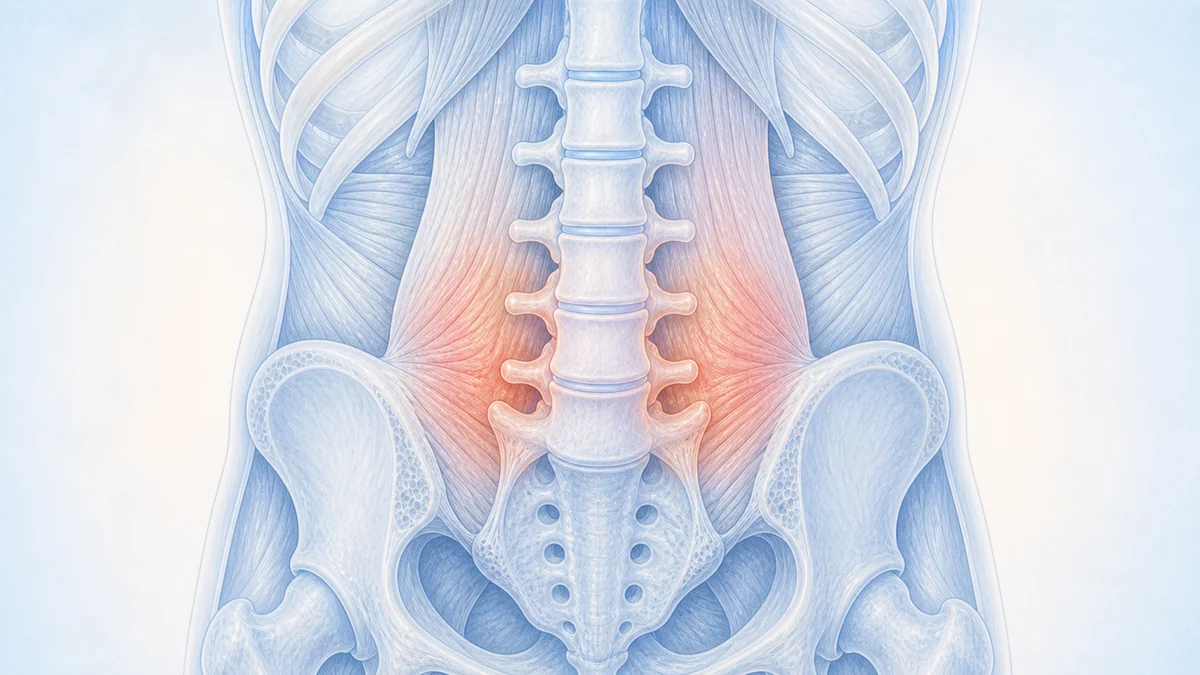
An awkward movement, a load lifted too quickly, sometimes nothing at all: the lower back seizes up. Low back pain is one of the most common reasons for seeing a doctor — and, in the great majority of cases, it gets better by itself. Here is what genuinely helps, what delays recovery, and the signs that mean you should see a doctor without delay.
What is low back pain?
Low back pain is pain in the lower part of the back, around the lumbar vertebrae. It usually comes from the muscles, ligaments and joints that support the spine — not from serious damage. Doctors call this non-specific low back pain, and it accounts for the vast majority of back trouble.
Lumbago is its acute form: a sudden episode of low back pain, often triggered by a perfectly ordinary movement, that quite literally locks you up. Frightening, but rarely serious.
What hurts, and what a scan cannot show
A stubborn myth holds that every back pain must match visible damage. That is wrong, and knowing it changes how you get through the episode:
- a normal X-ray or MRI does not rule out pain — it often comes from the muscles and joints, which do not show up on these images;
- conversely, worn discs and osteoarthritis are found in people who have no pain at all: their presence does not explain everything;
- imaging is useful only if it changes what should be done — and that is for the doctor to judge, based on the examination.
In other words: non-specific low back pain is not diagnosed from a scan, but from your account of the pain and a clinical examination.
Low back pain, sciatica, slipped disc: do not confuse them
These words describe different situations:
- low back pain: the pain stays in the lower back;
- sciatica: the pain travels down into the buttock and the leg, sometimes as far as the foot, usually on one side only. It reflects irritation of a nerve root;
- a slipped (herniated) disc: a disc that bulges and can press on a nerve root. It can cause sciatica, but many slipped discs never hurt at all.
Clear-cut sciatica calls for a medical examination, if only to check the strength and sensation in the leg.
When should you see a doctor?
See a doctor without delay, the same day, if any of these signs is present:
- weakness in the leg or foot: a foot that catches on the ground, a leg that gives way;
- numbness around the genitals or the inner thighs, difficulty passing urine or incontinence — these signs require urgent medical attention;
- a fever together with the back pain;
- back pain that started after a fall or an accident, especially after the age of 50 or if you have osteoporosis;
- pain that wakes you at night, comes with weight loss, or occurs in someone with a history of cancer.
Outside these situations, medical advice is still worthwhile if the pain does not improve after a few days, if it keeps coming back, or if it stops you from working.
What genuinely helps
Treating non-specific low back pain comes down to a few simple things, but they matter:
- keep moving: prolonged bed rest makes things worse and drags the episode out. Keep up gentle activity, adjusted to the pain;
- relieve the pain so that you can move — a simple painkiller such as paracetamol is usually enough;
- local heat, which relaxes the muscles;
- return to your activities gradually, without waiting for the pain to disappear completely.
What does not help, and may even do harm: staying in bed for days, wearing a support belt all the time, or piling up scans for non-specific low back pain.
How long it lasts
Most acute episodes of low back pain improve noticeably within a few days and settle in two to six weeks. Pain that persists beyond three months is called chronic: it needs a different approach, in which regular physical activity and muscle strengthening become the main treatment.
Recurrence is common and does not mean something is getting worse. It is the rule rather than the exception.
Stopping it from coming back
A few habits markedly reduce the risk of another episode:
- regular physical activity, even moderate: walking, swimming, cycling;
- strengthening the core muscles, more useful than avoiding movement;
- bending your knees to lift a load, keeping the object close to your body;
- changing position regularly if you sit for long periods at work;
- dealing with stress and lack of sleep, which lower the pain threshold.
Back pain and video consultation
Back pain lends itself particularly well to a remote consultation: the diagnosis rests above all on your account of the pain and on checking for warning signs. Careful questioning makes it possible to recognise non-specific low back pain, rule out what needs ruling out, and give you a clear plan — without having to travel when you can barely walk.
When a physical examination is needed — testing the strength of a leg, the reflexes, the sensation — a home visit makes perfect sense: this is precisely the situation in which leaving the house is hardest.
Consult Dr Nathalie Gozlan
Dr Nathalie Gozlan, a general practitioner, sees patients with back pain — through home visits across the Sharon region (Netanya, Kfar Saba, Raanana, Kadima-Tzoran, as well as the surrounding moshavim and kibbutzim), or by video consultation anywhere in Israel, in English, Hebrew and French.
An examination, treatment to get you through the worst of it, and a sick note if needed: in most cases, a single consultation is enough to get things moving again.
Frequently asked questions
Should you stay in bed when your back hurts?
No. It is in fact the main reflex to avoid: beyond a day or two, bed rest prolongs the episode and weakens the muscles. The aim is to relieve the pain enough to keep moving, adjusting your activity as you go.
Do you need an X-ray or an MRI?
For non-specific low back pain, no: these tests do not change the treatment, and they often show ordinary wear and tear that causes worry without explaining the pain. Imaging is reserved for situations with warning signs or for pain that persists, and that is for the doctor to judge.
How do you know if it is sciatica?
When the pain travels down into the buttock and the leg, usually on one side only, sometimes as far as the foot. Sciatica deserves a medical examination, in particular to check the strength and sensation in the leg. Weakness in the foot means you should see a doctor the same day.
Can back pain be treated in a video consultation?
Yes, in the usual case of non-specific low back pain: the diagnosis rests on your account of the pain and on checking for warning signs, and a prescription can be issued during the consultation. If a physical examination is needed, a home visit is offered — this is precisely the situation in which travelling is difficult.