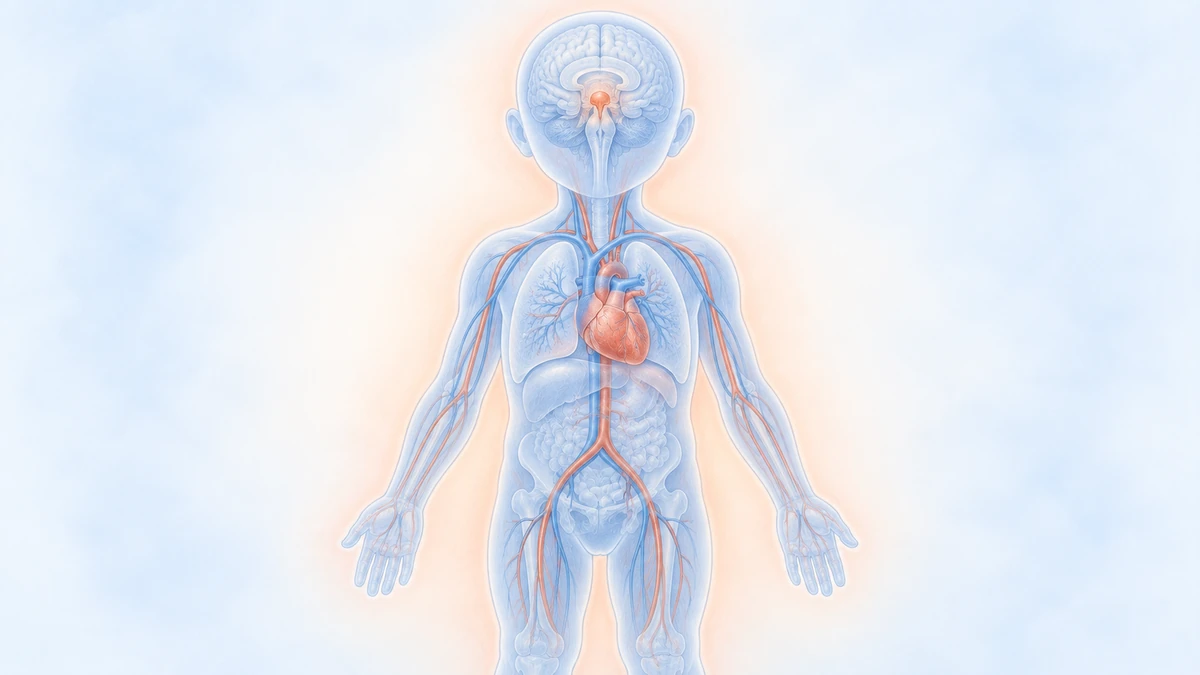
A child who feels hot, is grumpy and eats less: fever in children is one of the most common reasons for taking a child to the doctor. It worries parents a great deal, but it usually comes with a viral infection that is not serious. What matters is spotting the rare situations that do need prompt medical advice.
What counts as a fever in children?
Fever in children is defined as a temperature of 38 °C or more, measured at rest and without heavy clothing. A slightly raised temperature after running around, a bath or under several blankets is not a fever.
In babies, a rectal temperature is still the reference: it is the most reliable. In older children, an ear or underarm thermometer is acceptable, bearing in mind that it is a little less accurate. Forehead thermometers, or a hand on the forehead, only give a rough idea.
A defence, not an illness
A fever is not an illness. It is the body's normal response as it fights off an infection. It does not damage the brain, and it does not keep climbing indefinitely.
In the vast majority of cases, the cause is a common viral infection:
- a cold, a runny nose with a sore throat, the flu;
- a stomach bug (gastroenteritis);
- bronchiolitis in babies;
- roseola, with a rash that appears as the fever goes down.
Other causes need specific treatment: an ear infection, tonsillitis, a urinary tract infection (common in babies, sometimes with no sign other than the fever), pneumonia. A fever in the days after a vaccination is also common and usually short-lived.
How your child seems matters more than the number
A temperature of 39 or 40 °C is not necessarily more serious than one of 38.5 °C. What counts is how your child is behaving.
A child who plays, smiles, drinks and stays alert when the fever comes down is reassuring, even with a high reading. On the other hand, a child who is listless, pale or greyish, whimpering, or hard to wake is a concern, even if the temperature is only moderate.
When to call 101: emergency signs
Call 101 (Magen David Adom) straight away if you notice any of these signs:
- red or purple spots that do not fade when you press a clear glass against them (purpura);
- a stiff neck (the child cannot bend their head forward) or, in a baby, a bulging fontanelle (the soft spot on the head);
- unusual drowsiness, a floppy child who is hard to wake or no longer responds normally;
- difficulty breathing: fast breathing, the skin pulling in under the ribs, bluish lips;
- grey or mottled skin, cold hands and feet;
- signs of dehydration: a dry mouth, dry nappies for several hours, sunken eyes;
- a seizure (fit).
In a baby under 3 months, any temperature of 38 °C or more means you should seek emergency care, even if the baby seems well. At this age, a serious infection can hide behind a fever with no other sign.
When to see a doctor the same day
If none of these emergency signs is present, see a doctor the same day if:
- your child is between 3 and 6 months old;
- the fever has lasted more than 48 hours in a child under 2, or more than 72 hours in an older child;
- the fever comes back after a few days of improvement;
- your child is drinking little, vomiting or has heavy diarrhoea;
- they complain of pain: in the ear, the throat, the tummy, or when passing urine;
- they have a long-term illness or a weakened immune system;
- the fever starts after a trip to a tropical country.
Easing your child's discomfort
The aim is not to bring the number down at all costs, but to ease your child's discomfort. A few simple measures help:
- take off extra layers: a light bodysuit or pyjamas, in a room at a normal temperature;
- offer drinks often, in small amounts;
- no cold baths or ice-cold wraps: they are uncomfortable and do not help.
If your child is uncomfortable, paracetamol (acetaminophen) is the first-choice medicine. Ibuprofen is an alternative, unless there is a reason to avoid it (chickenpox, dehydration, a baby under 3 months). The dose is worked out according to the child's weight, not their age: follow the leaflet or your doctor's advice.
Do not alternate the two medicines without medical advice. And never give aspirin to a child.
Febrile seizures
Some children, roughly between 6 months and 5 years old, have a seizure as their temperature rises: loss of consciousness, jerking movements, a fixed stare. It is very frightening to watch, but it is usually harmless and leaves no lasting effects.
During the seizure: lay your child on their side, move away anything that could hurt them, put nothing in their mouth and note the time. Call 101, especially if it is a first seizure, if it lasts more than 5 minutes, if your child has trouble breathing or does not wake up normally afterwards. A first seizure should always be followed by a medical examination.
Fever in children and video consultation
Fever in children often lends itself well to a remote consultation: most of the assessment rests on how the child seems overall. On video, the doctor can watch your child move, breathe and respond, and check for signs of dehydration. Careful questions about how long the fever has lasted and any other symptoms then point either to simple monitoring or to an examination.
A baby under 3 months, on the other hand, or a child who seems unwell, needs to be examined: a home visit is then offered, or 101 if there is an emergency sign.
Seeing Dr Nathalie Gozlan
Dr Nathalie Gozlan, a general practitioner and a specialist in emergency medicine, sees babies and children with a fever — as a home visit in the Sharon region (Netanya, Kfar Saba, Raanana, Kadima-Tzoran, as well as the moshavim and kibbutzim of the area), or by video consultation anywhere in Israel, in English, Hebrew and French.
Spots that do not fade, drowsiness or difficulty breathing cannot be assessed remotely: call 101.
Frequently asked questions
Is a fever of 39 °C in a child serious?
Not in itself. A temperature of 39 °C is common with everyday viral infections. What matters is how your child is doing: if they drink, play and stay alert, that is reassuring. A baby under 3 months with a fever, however, must be seen urgently.
How do I take a baby's temperature?
In babies, a rectal reading is the most reliable. In older children, an ear or underarm thermometer is fine, although slightly less accurate. Forehead thermometers only give a rough indication.
Should I wake a child with a fever to give them their medicine?
No. The medicine is there to ease discomfort, not to bring the number down at all costs. A child who is sleeping peacefully can be left to sleep. If, on the other hand, your child is hard to wake or unusually floppy, call 101.
Can a fever in children be assessed by video consultation?
Often, yes: on video, the doctor can observe your child's behaviour, breathing and signs of dehydration, and decide what to do next. A baby under 3 months, or a child who seems unwell, must be examined in person, at a home visit or in the emergency department. If there is a warning sign, the right number is 101.