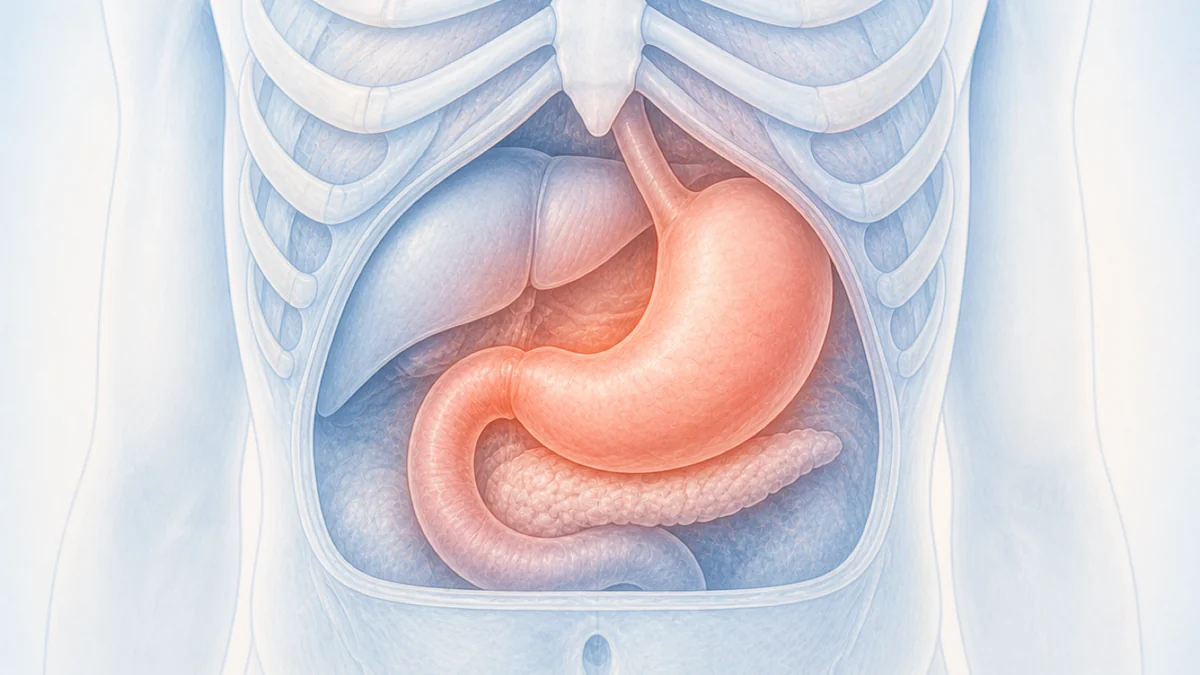
Stomach pain in the pit of the stomach, between the ribs and the navel, is one of the most common reasons for seeing a doctor. Most of the time, it comes from the stomach itself. But it is also one of the most misleading pains in medicine: the heart, the gallbladder and the appendix can all make themselves felt there. Here is how to make sense of it.
Stomach pain: where it hurts, and why it matters
With stomach pain, the abdomen is read by zones, and the location points towards the diagnosis:
- in the pit of the stomach, below the breastbone: the stomach, the oesophagus — but also the heart;
- under the ribs on the right: the gallbladder, the liver;
- lower right: the appendix;
- lower left: the colon;
- around the navel: the small intestine — and, in adults, often the start of appendicitis.
Pain that moves is particularly informative: pain that begins around the navel and migrates to the lower right within a few hours suggests appendicitis until proven otherwise.
The trap to know about: the heart can hurt in the stomach
A heart attack affecting the lower wall of the heart frequently presents as pain in the pit of the stomach, with nausea and sweating — exactly the picture of a “bad bout of indigestion”. It is one of the classic causes of delayed diagnosis, particularly in women, in people with diabetes and in older people.
Call 101 (Magen David Adom) if pain in the pit of the stomach comes with sweating, faintness, breathlessness, pain spreading to the jaw, neck or arm, or if it comes on with exertion — even without any pain in the chest.
The most common causes of stomach pain
In the vast majority of cases, stomach pain has a digestive cause and is not immediately serious:
- acid reflux (GORD): a burning feeling rising behind the breastbone, worse when lying down or after a heavy meal;
- gastritis: pain or a feeling of heaviness, often linked to anti-inflammatory painkillers, alcohol or stress;
- stomach ulcer: pain that follows the rhythm of meals, sometimes eased by eating;
- gallstones: an intense attack under the ribs on the right, one to several hours after a fatty meal;
- functional bowel disorders: chronic pain, bloating, irregular bowel habit, with no detectable abnormality;
- pancreatitis: intense pain boring through to the back, often after a fatty meal or alcohol — it calls for urgent medical advice;
- gut infection: pain with diarrhoea, nausea, sometimes fever.
The warning signs
Seek help urgently for stomach pain — 101 or an emergency department — if any of these signs is present:
- pain that is sudden, intense and at its worst from the outset;
- a hard, rigid abdomen, painful at the slightest touch;
- vomiting blood, or black, tarry stools;
- pain with fever and shivering, especially if the skin or the whites of the eyes turn yellow;
- being unable to pass wind or stools, with bloating and vomiting;
- pain in the pit of the stomach with sweating, faintness or breathlessness.
- in a pregnant woman, especially in the last trimester, a band of pain across the upper abdomen — all the more so with headaches, visual disturbance or sudden swelling.
See a doctor the same day if stomach pain lasts more than a few hours without improving, if it wakes you at night, if it comes with weight loss, difficulty swallowing or repeated vomiting, or if it occurs in someone who is pregnant, elderly or immunocompromised.
What helps, and what makes it worse
If you have stomach pain, a few simple principles while waiting for medical advice:
- eat smaller, more frequent meals, avoid heavy evening meals and go to bed at least two hours after eating;
- raise the head of the bed if reflux troubles you at night — more effective than an extra pillow;
- avoid anti-inflammatory painkillers (such as ibuprofen and related drugs): they attack the stomach lining and can turn gastritis into an ulcer;
- limit alcohol, tobacco, coffee and very fatty foods while the pain lasts.
A painkiller such as paracetamol remains an option for the pain, at the doses stated on the leaflet and without combining it with alcohol. On the other hand, taking an antacid for weeks on end without medical advice amounts to masking a symptom without ever looking for its cause.
What a doctor looks for
For stomach pain, careful questioning does half the work: where, since when, how it relates to meals, which medicines you take, which other symptoms come with it. Examining the abdomen pinpoints the painful area and looks for the signs that should cause concern.
Depending on the picture, this may be followed by a blood test, a test for Helicobacter pylori — the bacterium responsible for many ulcers, and one that can be treated —, an ultrasound scan or a gastroscopy. These investigations are not routine: they are decided case by case.
Stomach pain and video consultation
Stomach pain can be assessed by video: careful questioning — how the pain relates to meals, burning, reflux, medicines taken, weight loss — makes it possible to pick out the signs that are reassuring and those that call for an examination or a gastroscopy, and to prescribe a trial treatment where that is appropriate. Pain that is severe, sudden or radiating calls for an examination without delay, not a video consultation.
See Dr Nathalie Gozlan
Dr Nathalie Gozlan, a general practitioner, sees patients with stomach pain or upper abdominal pain: examination, checking for warning signs, treatment and referral for any useful investigations — as a home visit in the Sharon area (Netanya, Kfar Saba, Raanana, Kadima-Tzoran, as well as the moshavim and kibbutzim of the region), or by video consultation anywhere in Israel, in English, Hebrew and French.
Stomach pain that persists, keeps coming back or worries you deserves a proper look — often a single consultation is enough to reassure you, or to act in time.
Frequently asked questions
Heartburn: when should I worry?
Occasional reflux after a heavy meal is commonplace. You should see a doctor if it becomes a daily occurrence, if it wakes you at night, if it comes with difficulty swallowing, weight loss, vomiting blood or black, tarry stools, or if it appears for the first time after the age of 50.
How can I tell stomach pain from heart pain?
You cannot always tell, and that is precisely the problem: a heart attack affecting the lower wall of the heart often presents as indigestion. Sweating, faintness, breathlessness, pain spreading to the jaw or arm, or pain brought on by exertion should prompt a call to 101, even if the pain sits in the pit of the stomach.
Can stomach pain be caused by stress?
Yes: stress genuinely alters how the gut moves and how pain is perceived, and functional bowel disorders are common. But it is a diagnosis made only after ruling out the other causes, particularly if there is weight loss, bleeding or pain at night.
Can stomach pain be treated by video consultation?
Often, yes: careful questioning goes a long way, and simple reflux or gastritis can be managed very well remotely, with any useful investigations prescribed straight away. On the other hand, an abdomen that is tender to the touch, intense pain or warning signs require a physical examination — a home visit or the emergency department, depending on the picture.