A child who wakes up crying, keeps pulling at one ear and turns feverish a few days into a cold: acute middle ear infection is one of the commonest reasons for a doctor's visit before the age of six. Here is how to recognise it, how to ease it, and when to have it checked.
Why do children get ear infections?
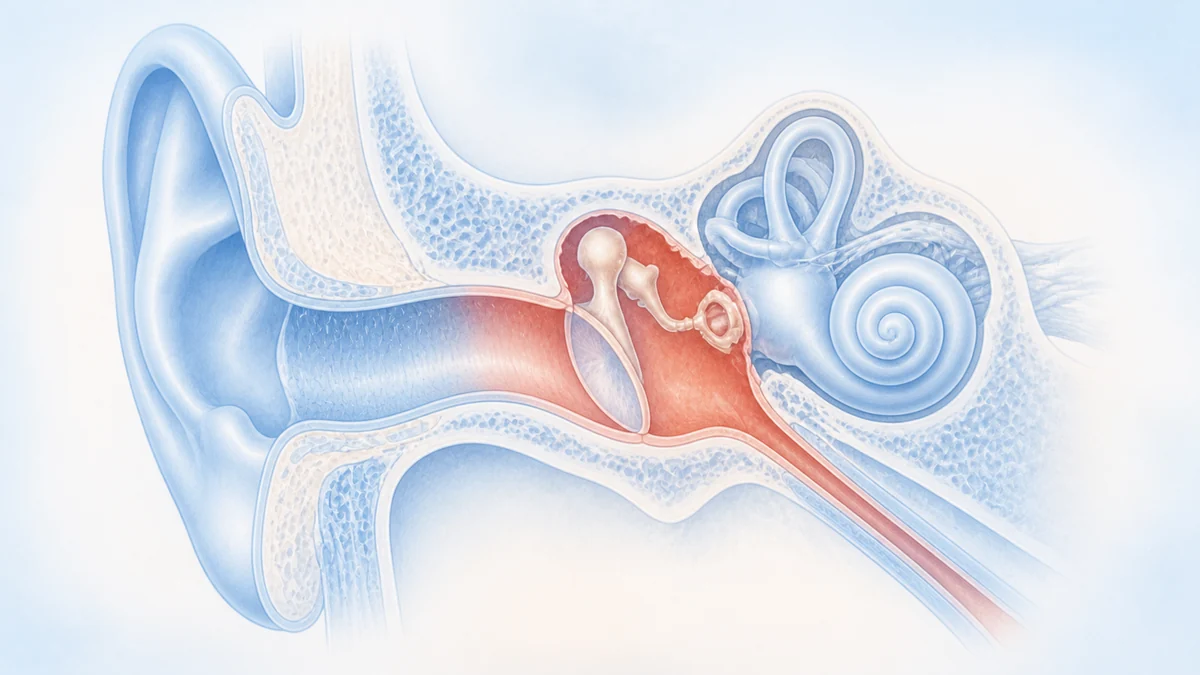
The middle ear connects to the back of the nose through a narrow channel, the eustachian tube. In a young child that tube is short and almost horizontal, so mucus from a cold travels up it easily and gets infected. This is why an ear infection almost always turns up a few days into a cold, and why it becomes uncommon after the age of six or seven, once the anatomy changes.
Daycare, exposure to cigarette smoke and bottle-feeding while lying flat all raise the risk.
Symptoms
- ear pain, often coming on suddenly and worse at night, when the child lies down;
- fever, a few days into a cold;
- in a baby, who cannot yet point to the pain: unusual crying, waking at night, refusing the bottle, irritability, sometimes diarrhoea or vomiting;
- a child who keeps pulling at one ear or rubbing the side of the head;
- sometimes discharge from the ear: the eardrum has perforated and the pain stops abruptly — alarming to see, but the outlook is usually good. It still needs to be checked by a doctor.
Hearing that stays muffled after the episode, with no pain and no fever, points to fluid behind the eardrum, sometimes called glue ear: the fluid can linger for several weeks. It needs to be checked, but not treated with antibiotics.
Are antibiotics always needed?
No — and this is a real change from what many parents remember. Treatment depends on the child's age and on how unwell they are:
- under two, when both ears are involved, or when the ear is discharging, antibiotics are usually prescribed;
- over two, for a one-sided infection with mild symptoms, watching and waiting for 48 to 72 hours while treating the pain is an accepted option: most ear infections clear on their own;
- in every case, pain relief comes first and starts straight away.
That decision assumes someone has actually looked at the eardrum. It is the only thing that settles the question: neither the fever nor how hard the child is crying is enough.
Relieving the pain
Paracetamol (acetaminophen) is the first-line treatment and should be given without waiting: the pain of an ear infection is severe and entirely controllable. Rinsing the nose with saline several times a day helps too, by clearing the back of the nose where the problem starts.
Ear drops must never be used without medical advice: if the eardrum is perforated, some of them are dangerous for the inner ear. Cotton buds have no place inside the ear either.
When to see a doctor
- in any baby under six months with a suspected ear infection;
- with a high fever, an unusually listless child, or refusal to drink;
- if the pain lasts more than 48 hours despite paracetamol;
- if fluid is draining from the ear;
- with swelling, redness or tenderness behind the ear that pushes it outward: this sign needs urgent assessment;
- if the child still seems to hear less several weeks after the episode.
Swimmer's ear: a different problem
In summer, ear pain that starts after repeated swimming and gets worse when you tug on the outer ear points instead to an outer ear infection, swimmer's ear: it is the ear canal that is infected, not the middle ear. It is treated with drops, not with antibiotics by mouth — which is exactly why guessing is a bad idea.
Seeing Dr Nathalie Gozlan
Dr Nathalie Gozlan is a general practitioner; she sees children for earache — at home across the Sharon region (Netanya, Kfar Saba, Raanana, Kadima-Tzoran and the moshavim and kibbutzim nearby), or by video consultation anywhere in Israel, in English, Hebrew and French.
A home visit makes particular sense here: looking at the eardrum is what determines the treatment, and it saves you taking a feverish child out in the evening.
Frequently asked questions
Are ear infections contagious?
The ear infection itself does not pass from one person to another, but the cold that caused it does. That is what goes round families and daycare groups.
My child has a fever and cries at night — does that mean an ear infection?
Not necessarily. Ear pain at night after a cold is suggestive, but there are other causes — teething, tonsillitis, swimmer's ear. Only looking at the eardrum can settle it.
Can we fly with an ear infection?
Better to ask first: the pain often gets worse on descent. Pain relief, swallowing during landing and rinsing the nose before the flight all help a great deal.
Can an ear infection be diagnosed by video consultation?
A video consultation can assess the situation, start pain relief immediately and tell you what to do next. But making the diagnosis means seeing the eardrum: with children, a home visit is usually offered right afterwards.